Best SEO APIs in 2026: what developers should use for data, SERPs, and automation
Compare leading SEO APIs by data coverage, SERP controls, async handling, pricing model, workflow fit, and the engineering work left to build.
Engineering teams and growth engineers building agentic SEO features, internal tools, or workflow automation
SEO API / AI agents
There is no single best SEO API. For agent workflows, AgentSEO is our first pick when the next step needs evidence and a decision-ready response. DataForSEO is the broader choice for raw search datasets. SerpApi is the cleaner fit for focused SERP retrieval. Google Search Console remains the first-party source for your own Google performance.
Most production teams need a small stack. The useful decision is which source should own each job, what your team still has to build, and what one completed workflow actually costs after retries and normalization.
AgentSEO publishes this guide and appears in the comparison. That relationship is explicit. The external product facts below come from provider documentation checked on September 15, 2026; the recommendations come from a seven-query US desktop SERP study, 41 ranking-page targets, and live workflow tests described below.
Best Next Step
Test the workflow shape before you commit to the stack
Run AgentSEO in the playground, then compare that contract against the workflow bundles and runtime paths you actually plan to operate.
Best SEO APIs by use case
These tools solve different problems. The right first choice depends on the data you need and what happens after the response arrives.
A useful shortlist does not rank every provider on one artificial scale. Assign each option a job, then test the contract that matters for that job.
The table is a decision map, not a universal ranking. Product scope changes. Check the linked first-party documentation, confirm the plan that exposes the endpoint you need, and run the same request you expect to run in production.

- Best for agent workflows: AgentSEO.
- Best for broad raw SEO datasets: DataForSEO.
- Best for focused multi-engine SERP retrieval: SerpApi.
- Best for an agency SEO suite with API access: SE Ranking.
- Best for enterprise SERP infrastructure: Bright Data.
- Best for first-party Google performance: Search Console API.
- Best for specialist backlink metrics: compare Moz, Ahrefs, and Majestic against the exact link job.
| Option | Best for | What you receive | Main tradeoff |
|---|---|---|---|
| AgentSEO | Agents and internal tools that need a decision-ready response | Compact evidence, job state, recommendations, and workflow routes through REST or MCP | It is opinionated and is not a replacement for every raw provider endpoint |
| DataForSEO | Broad raw SEO and search datasets | SERPs, keywords, backlinks, on-page, domain, business, and other provider-native datasets | Broad coverage means more contracts, normalization, and job handling for your team |
| SerpApi | Focused multi-engine SERP retrieval | Structured search-result responses across supported engines | You still own interpretation, storage, monitoring, and action routing |
| SE Ranking | Agency and suite workflows that also need an API | SEO and AEO data through a broader platform and API surface | API access and allowances depend on the current commercial plan |
| Bright Data | SERP collection at infrastructure scale | Location-aware SERP results through synchronous and asynchronous delivery options | More infrastructure than a small internal workflow may need |
| Google Search Console API | Your site's first-party Google performance | Clicks, impressions, CTR, position, query, page, country, device, and search-appearance data | It is not competitor data, and some query rows can be withheld |
| Moz, Ahrefs, or Majestic | Link and authority research | Provider-specific backlink indexes and proprietary link metrics | Coverage, metric definitions, and API access are not interchangeable |
How we evaluated the options
The method separates what providers document, what we observed in search, and what we tested ourselves.
On September 15, 2026, we sampled seven Google US desktop queries around `best SEO API`, `SEO API tools`, integration, automation, and day-to-day data pulling. We collected 41 unique top-ten page targets and read 36 successfully. Five pages blocked automated retrieval; we did not use those pages for detailed product claims.
We also ran live DataForSEO calls for the SERPs and available keyword metrics. One query returned a provider-side partial-result error after two attempts. That failure belongs in the method because retry behavior is part of the product experience, but one failed task is not evidence of a general reliability problem.
Provider capabilities in this guide come from first-party documentation. The shortlist order is our editorial judgment. AgentSEO workflow claims come from our own docs and request tests. Prices are deliberately described by model rather than copied as fixed numbers because plans change.
Related reading
| Evidence | Scope | What it supports | Limit |
|---|---|---|---|
| US SERP study | 7 queries; US; desktop | Intent, result formats, recurring providers, and comparison expectations | A dated sample, not every query or personalized result |
| Ranking-page review | 41 targets; 36 read | How current winners answer the buyer's question | Five pages blocked full automated retrieval |
| Provider documentation | First-party pages checked September 15, 2026 | Documented capabilities, access methods, and pricing model | Documentation does not prove comparative quality |
| AgentSEO tests | Live requests and repository contracts | Payload shape, workflow behavior, and failure handling | First-party evidence from the publisher of this guide |
| Search Console export | This URL; latest supplied 28-day report | Impressions, clicks, CTR, position, country, and device mix | It cannot prove why a ranking changed or whether a reader was satisfied |
What users report after using these tools
Review sites add operating context, but they do not replace a controlled API test.
I reviewed current G2 and Capterra feedback for recurring experience patterns, not isolated praise. The samples are not equivalent. SerpApi reviews focus closely on the API. SE Ranking and Bright Data reviews often describe the wider platform. DataForSEO has a much smaller G2 sample, so a single negative review can distort the picture.
Treat these as diligence prompts. Reviews can be invited, incentivized, self-selected, or written for a different workload. They tell you what to test next; they do not prove which provider will perform best in your system.
Related reading
DataForSEO reviews on G2
A small, mixed review sample that is useful for questions, not a reliability benchmark.
SerpApi reviews on G2
Review themes around integration, documentation, support, and pricing fit.
SE Ranking reviews on Capterra
Broader suite feedback covering rank tracking, reporting, limits, and add-on costs.
Bright Data reviews on G2
Platform-level feedback about collection, support, pricing, and learning curve.
- DataForSEO experience: users repeatedly mention dataset breadth and pay-as-you-go value; reported friction includes endpoint complexity, pricing details, and occasional data or support complaints.
- SerpApi experience: users often praise fast setup, clear documentation, integration, and support; the recurring objection is subscription fit for smaller or irregular workloads.
- SE Ranking experience: users value rank tracking, audits, reporting, and having several SEO jobs in one interface; common friction includes feature limits, add-on costs, interface changes, and slower work on larger projects.
- Bright Data experience: users frequently mention collection breadth and support; price, learning curve, and the size of the platform are the recurring reasons smaller teams hesitate.
- AgentSEO experience: our evidence is still first-party. The workflow tests support the contract claims in this guide, but there is not yet a large independent review sample to summarize honestly.
| Provider | Signal worth testing | Question to ask in your trial | Evidence limit |
|---|---|---|---|
| AgentSEO | Compact decision-ready output | Can the next tool act without another normalization or summary step? | First-party tests; no large independent review sample |
| DataForSEO | Breadth and usage-based economics | Which task mode, endpoint, and row charges apply to the real batch? | Small G2 sample and mixed workloads |
| SerpApi | Developer setup and supported result types | Does the monthly allowance fit bursty or seasonal usage? | Small review sample, though closely aligned with API use |
| SE Ranking | Suite workflow and reporting | Is the required API surface included, and how does it behave at project scale? | Most reviews assess the suite, not the API contract |
| Bright Data | Collection infrastructure and support | Does the workload need this breadth enough to justify cost and setup? | Most reviews span the wider data platform |
Use a buyer scorecard built for agent workflows
Feature grids hide operating risk. A short scorecard brings the real costs back into view.
Endpoint count is easy to compare and rarely where the workflow breaks. The expensive failures are contract drift, unclear async states, silent partial results, rate limits, and payloads that need another model call before the next tool can use them.
Score the full operating path. A cheap request can become an expensive workflow after polling, retries, storage, normalization, and human review.
| Dimension | Why it matters | What a strong score looks like |
|---|---|---|
| Response compactness | LLM and queue-based workflows pay for every unnecessary field | The useful summary and evidence are obvious without reading a giant blob |
| Async job clarity | Polling and retries become brittle fast when job state is vague | Queued, running, completed, and failed states are explicit and boring |
| Contract stability | Prompting and downstream tools break when field names drift | The contract stays predictable across repeated runs |
| Location and device control | A rank check is useless if you cannot rerun the same context cleanly | Location, language, and device are easy to specify and repeat |
| Actionability | A result that still needs another interpretation layer is slower and more expensive | The next branch is already clear to a tool or reviewer |
| Evidence and traceability | Humans still need to review, debug, and trust the result | The output shows what happened and why |
| Provenance and freshness | Cached, historical, and live data support different decisions | Every result exposes its source, collection time, and cache behavior |
| Partial-result behavior | A successful HTTP response can still contain an incomplete task | Partial work is explicit, typed, and safe to retry or route for review |
| Rate limits and concurrency | A demo request says little about a scheduled production queue | Limits are documented and the client can apply bounded backoff |
| Rerun consistency | Monitoring needs comparable inputs and outputs | The same context can be cached, replayed, and compared without hidden defaults |
| Versioning | Field changes can break downstream tools without warning | Schema changes, deprecations, and migration windows are documented |
| SERP freshness and feature coverage | Live-result workflows need a timestamp and explicit feature labels | Freshness, location, device, and detected features are inspectable on every run |
| Cost per completed workflow | Retries, polling, transformation, and review change the real unit cost | The team can price a successful end-to-end run, not only an API call |
Match the source to the SEO job
Most mature teams end up with a stack, not because they failed to choose, but because different SEO jobs need different source shapes.
Planning, monitoring, and action routing are not the same job. A keyword planning workflow wants demand and intent. A rank-monitoring workflow wants live positions and feature detection. An agent loop wants a contract that can move into a queue, a reviewer, or an automatic branch without another pile of glue code.
There is also a caller question now. If the caller is your backend, queue, cron, or webhook worker, REST is still the clean default. If the caller is Claude Code, Claude Desktop, or another MCP-aware host, the same workflow may deserve an MCP surface too.
That is why the most honest answer to `which SEO API is best` is often `best for which job` and `best for which caller`. The real win is choosing the narrowest source that answers the current job cleanly.
| Workflow job | Best source first | Why it fits |
|---|---|---|
| Keyword and category planning | Keyword research or broad SEO data API | Best for search demand, intent, and category comparison |
| Rank tracking and live SERP inspection | SERP or ranking API | Best for device-aware and location-aware live search results |
| Internal tooling and agent workflows | Workflow-shaped SEO API | Best when another system needs summary, evidence, and a next action |
| Interactive agent host usage | MCP surface on top of a workflow API | Best when the model should discover and call the workflow as a native tool |
| Historical traffic and page movement | Search analytics or webmaster data source | Best for clicks, impressions, CTR, and position history |
| Page extraction or technical checks | Crawler or extraction endpoint | Best for reading the page itself instead of only the SERP view |
What changes the recommendation
A provider can be right for one team and wrong for the next. The deciding factor is usually the work around the API.
Choose DataForSEO when breadth and low-level control justify a larger integration surface. Choose SerpApi when the product mainly needs structured search results and your team already owns the decision layer. Choose SE Ranking when API access belongs inside a wider agency or platform workflow. Choose Bright Data when collection scale and delivery infrastructure matter more than a compact application contract.
Use Google Search Console alongside those sources, not instead of them. It tells you how Google surfaces properties you can access. It does not provide a complete market view, and Google notes that the Search Analytics API may return top rows rather than every row.
Choose AgentSEO when the downstream consumer is an agent, queue, or reviewer that benefits from a smaller, opinionated response. Do not choose it merely because this article appears on AgentSEO. Choose it only if the workflow savings survive a real request.
Related reading
SE Ranking API documentation
Check the current API scope, access requirements, and workflow options directly with the provider.
SerpApi product documentation
Review supported engines, response examples, and integration documentation.
Bright Data SERP API
Review current delivery modes, location controls, and usage terms on the provider page.
| Option | Choose it when | Choose something else when | Pricing model to verify |
|---|---|---|---|
| DataForSEO | You need several search datasets and can own provider-native contracts | You only need a simple SERP response or want less integration work | Pay as you go by endpoint, priority, and task shape |
| SerpApi | SERP retrieval across supported engines is the main job | You need a broad SEO database or a decision-ready workflow result | Monthly search allowance and overage rules |
| SE Ranking | The API complements an SEO platform your team already operates | You want a data-only layer without suite coupling | Plan eligibility, API units, and renewal terms |
| Bright Data | Collection scale, geographies, and delivery modes are core requirements | A smaller direct application contract is enough | Usage volume, request type, and current free allowance |
| Search Console API | You need first-party Google performance for properties you can access | You need competitor, backlink, or complete market data | No product fee; OAuth, quota, storage, and engineering still have cost |
| AgentSEO | The next consumer needs evidence, status, and recommendations in one workflow | Your team wants every raw field and will build the decision layer | Subscription allowance and cost per completed workflow |
Run a real smoke test before you buy
One live request plus one contract reduction tells you more than a long vendor demo.
Make one real request with the location, language, device, and depth your workflow will actually use. Then reduce the response to the fields the next branch needs. If that reduction is awkward, the expensive part of the implementation is still hiding in the contract.
Test the failure path as well. During this article's research run, one DataForSEO keyword task returned a provider-side partial-result error after two attempts. Seven SERP tasks succeeded. That single failure does not establish a reliability rate, but it did confirm that the client needs bounded retries and an explicit terminal state.
Related reading
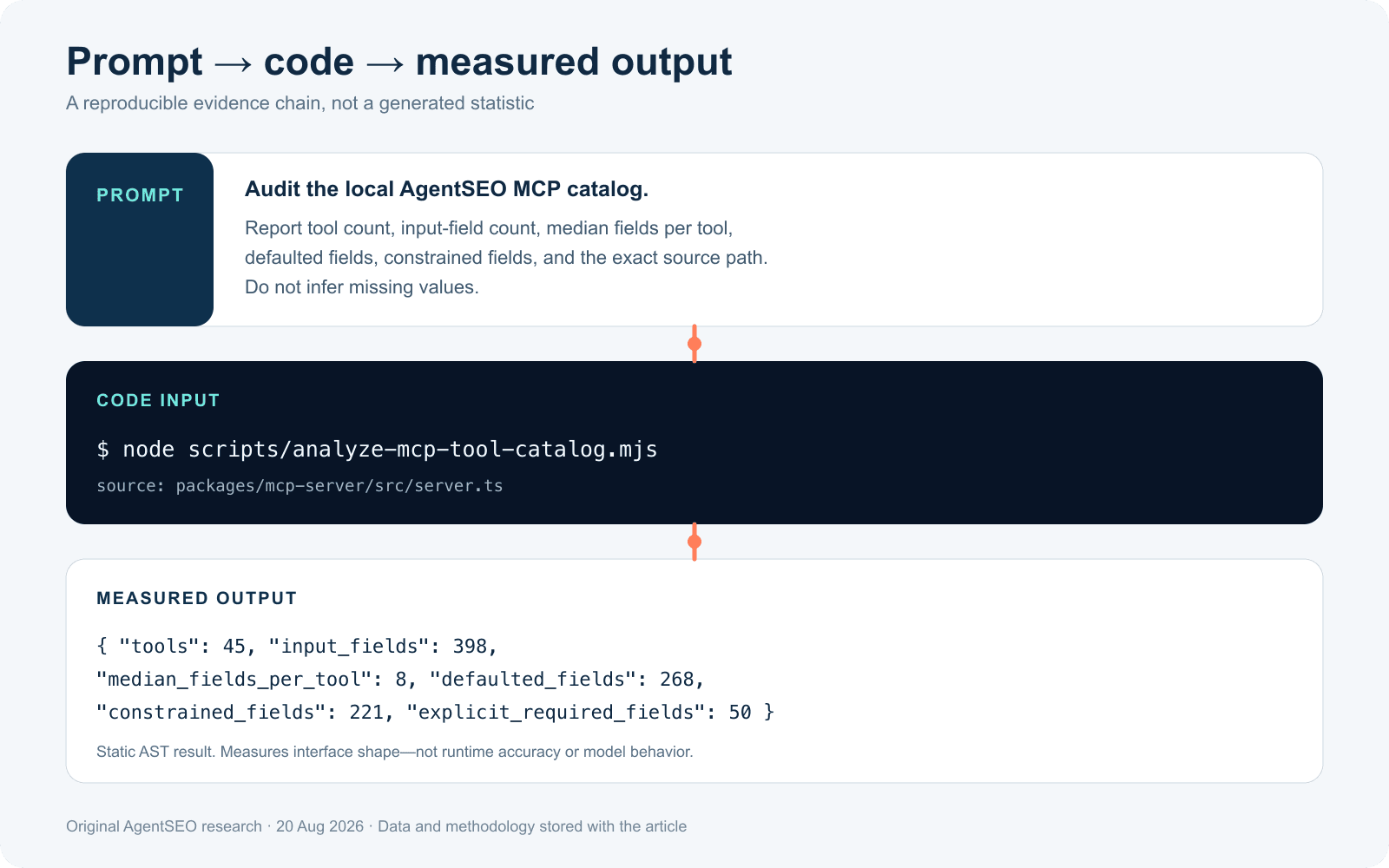
curl -s -X POST "https://www.agentseo.dev/api/v1/search?sync=true" \
  -H "content-type: application/json" \
  -H "x-api-key: YOUR_AGENTSEO_API_KEY" \
  -d '{
    "query": "best seo api for ai agents",
    "location": "United States",
    "device": "desktop"
  }' | jq '{
    status,
    summary,
    recommended_actions,
    evidence_count: (.evidence // [] | length)
}'| Check | Record | Why it changes the decision |
|---|---|---|
| Request context | Query, market, language, device, and depth | Hidden defaults make comparisons impossible to rerun |
| Response | HTTP status, task status, and partial-result state | A 200 response does not always mean the job is complete |
| Payload | Bytes received and fields passed downstream | Transformation and model-token costs can exceed request cost |
| Freshness | Collection time, cache behavior, and rerun result | Live and cached data support different decisions |
| Failure | Retry, backoff, partial result, and terminal error | The failure contract determines whether automation is safe |
| Human review | Evidence required to approve the next branch | An unexplained recommendation creates operating risk |
| Cost | Total cost per successful end-to-end workflow | Price per call hides polling, retries, and normalization |
Pair API market data with first-party Search Console evidence
An SEO API shows the market and result page; Search Console shows how Google is already surfacing your own pages.
Do not let a vendor dataset replace your first-party baseline. Search Console shows which pages and query families Google already tests. An SEO or SERP API adds competitors, result features, and rerunnable location controls. The useful workflow reconciles both sources without pretending they measure the same thing.
For this URL, the supplied 28-day Search Console export recorded 13,608 impressions, 4 clicks, 0.03% CTR, and an average position of 17.35. The United States accounted for 7,514 impressions. Those numbers justify preserving the URL and improving the answer. They do not prove quality, causation, or reader satisfaction.
Related reading
| Source | What it can support | What it cannot prove alone |
|---|---|---|
| Search Console Web performance | Queries, pages, clicks, impressions, CTR, and average position | Why a ranking changed or whether a reader was satisfied |
| Search Console Generative AI features | Which pages received impressions in supported Google AI surfaces | Citations across every answer engine or a direct ranking factor |
| SEO or SERP API | Competitor results, features, locations, devices, and repeatable market checks | Your site's conversions or Google's private ranking logic |
| Analytics and product events | Qualified visits, API-key creation, first successful request, and paid conversion | Unseen search demand or competitor visibility |
Where AgentSEO fits best
AgentSEO makes the most sense when the API response must move straight into an agent, queue, or review step.
AgentSEO publishes this guide, so here is the narrow claim I am willing to make. AgentSEO is built for developers and technical marketers who want a smaller interpretation layer between search data and the next action.
REST fits app, backend, queue, and webhook execution. MCP fits hosts such as Claude Code or Claude Desktop where the model needs to discover and call a scoped tool. The OpenClaw plugin is another access path for that runtime. These are caller choices on top of the workflow, not separate kinds of SEO data.
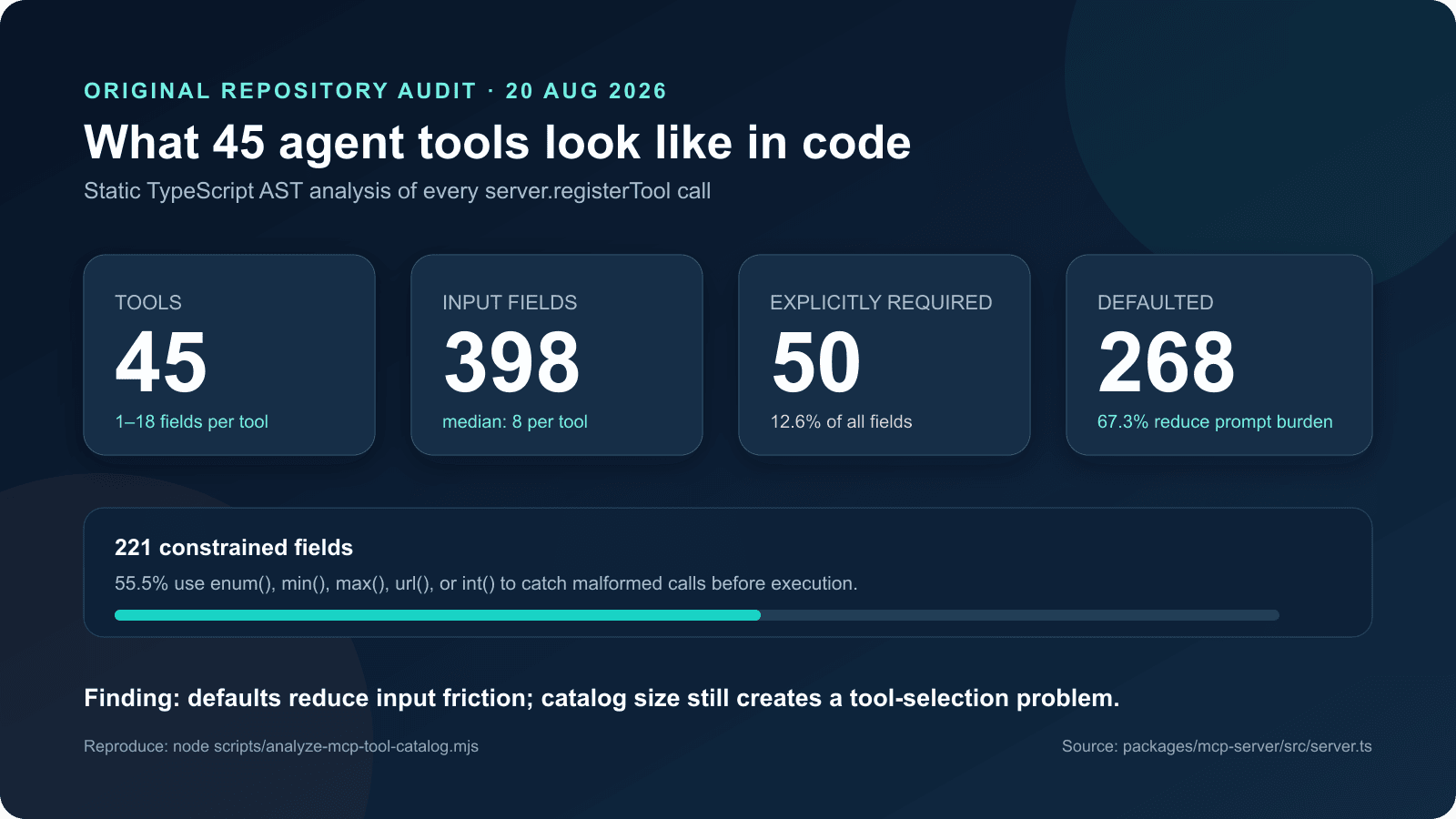
AgentSEO is a poor fit if your team wants every provider-native field or plans to build its own decision system. Direct access gives you more control. AgentSEO becomes interesting when fewer transformations, visible evidence, and a predictable next branch save more than the opinionated contract costs.
Do not take that on trust. Run the request above, inspect the result, force one failure, and compare the full workflow against a direct provider call.
Related reading
AgentSEO workflow bundles
Use this when the team wants to see how launch, refresh, AI visibility, programmatic SEO, and backlink work map into repeatable endpoint sequences.
MCP vs API for SEO workflows
Use this when the workflow category is clear but the caller boundary still needs a decision.
Rank tracking API guide: what to evaluate before you buy one
Use this when the real requirement is ranking and live SERP monitoring, not a broad SEO data layer.
SEO agent guide: how to build one without breaking production
Use this after the API decision if the next job is designing a safe runtime and review loop.
AgentSEO + Claude Code
Use this when the buyer already knows the workflow and now wants the MCP path inside an agent runtime.
- Use it when an agent needs concise evidence instead of a provider-native payload.
- Use it when a long-running job needs an explicit state and review path.
- Use it when product and growth teams need the finding and its support together.
- Use it when the next job is already bounded: publish QA, sitemap review, cannibalization analysis, content planning, or opportunity routing.
Keep the workflow moving
Test the workflow shape before you commit to the stack
Run AgentSEO in the playground, then compare that contract against the workflow bundles and runtime paths you actually plan to operate.

Daniel Martin
Cofounder, AgentSEO
Inc. 5000 Honoree and cofounder of AgentSEO and Joy Technologies. Daniel has helped 600+ B2B companies grow through search and now writes about practical SEO infrastructure for AI agents, MCP workflows, and REST-first execution systems.
Continue this path
Developers and growth engineers
Start with the infrastructure, workflow boundaries, and validation patterns that make AgentSEO feel credible in production.
Phase 1
MCP vs API: when REST still wins for SEO workflows
Most teams do not need to choose between MCP and APIs. Keep REST for durable SEO execution. Add MCP when Claude Code or another agent host should call the same workflow natively.
Phase 1
What should be measured in the playground before building a production workflow
A good playground session should answer whether the workflow is worth wiring into production, not just whether the API returned something. The key checks are output shape, decision quality, and operational fit.
FAQ
Questions teams usually ask next
What is the best SEO API in 2026?
There is no universal winner. DataForSEO is a strong starting point for broad raw SEO datasets, SerpApi for focused search-result retrieval, Google Search Console for your own Google performance, and AgentSEO for decision-ready agent workflows. The best choice is the one that completes your specific job with the least unsafe or expensive glue code.
What is the difference between an SEO data API, SERP API, and rank tracking API?
An SEO data API usually exposes stored or computed datasets such as keywords, links, domains, and audits. A SERP API retrieves a search-results page for a defined query and context. A rank tracking API repeats those checks over time and stores position history. Some providers cover more than one category.
Should I call DataForSEO directly or use a workflow layer?
Call DataForSEO directly when you want broad low-level access and can own normalization, polling, retries, and decision logic. Use a workflow layer when the next consumer benefits from a smaller response with evidence, status, and a recommended branch. Test both with the same production request before deciding.
Should I choose one SEO API or build a small stack?
Start with the narrowest source that completes the first job. Add another API only when you need a genuinely different source, such as combining Search Console performance with live competitor SERPs or backlink data. A small explicit stack is usually easier to trust than one provider forced into every role.
How should I compare SEO API pricing?
Calculate cost per completed workflow. Include the initial request, polling, failed tasks, retries, storage, payload transformation, model tokens, and human review. Also verify whether billing is per request, result, task, credit, or monthly allowance on the provider's current pricing page.
What happens when an SEO API hits a rate limit or returns partial data?
The client should identify rate limits and partial results separately, apply bounded backoff only where a retry is safe, and stop with an explicit terminal state when the retry budget is exhausted. Do not let an HTTP 200 response silently pass incomplete work downstream.
How do I test location accuracy in a SERP API?
Fix the query, country or city, language, device, search engine, and result depth. Record the collection time and cache status, then rerun the same request. Compare providers only when those inputs match and treat a localized API result as a reproducible observation, not a perfect copy of every user's personalized SERP.
Can I use an SEO API to build a custom reporting dashboard?
Yes, but decide who owns history, joins, and metric definitions first. Search Console can supply first-party clicks and impressions; market APIs can add rankings, competitors, links, and SERP features. Store source, collection time, location, device, and query context so the dashboard does not mix unlike measurements.
Should MCP replace REST for SEO automation?
No. REST remains the cleaner boundary for durable app, queue, cron, and webhook execution. Add MCP when an agent host needs to discover and call the same workflow interactively. In many systems, MCP is the agent-facing tool surface while REST remains the execution contract underneath.
More in this topic
Agentic SEO workflows and automation
Architecture
How to build an SEO MCP server that earns its runtime
Build an SEO MCP server around one workflow, typed tools, the right transport, bounded errors, and a host-level smoke test. Includes a TypeScript skeleton and real test evidence.
Workflow
SEO agent guide: how to build one without breaking production
Build an SEO agent with a bounded job, typed workflow state, validation, retry limits, and a human gate before it changes production.