AI Search Strategy: How to Optimize Your Website for Google AI, ChatGPT, and Perplexity
AI search changes how buyers discover brands. Learn how to make your website clearer, more useful, and easier for AI search systems to understand.
Founders, growth teams, agencies, and technical marketers building repeatable AI visibility workflows
AI Search / AI Visibility
Best Next Step
Turn the visibility lesson into a workflow
Use AgentSEO to inspect AI visibility, citations, competitors, and content gaps with outputs built for dashboards, APIs, and agent workflows.
Quick Brief
Best For
Founders, growth teams, agencies, and technical marketers building repeatable AI visibility workflows
Core Problem
AI search changes how buyers discover brands. Learn how to make your website clearer, more useful, and easier for AI search systems to understand.
Read Shape
5 min read with scannable sections, proof blocks, and direct next actions.
Proof Inside
You’ll Cover
- What AI search systems look for
- Step 1: Make your entity clear
- Step 2: Build pages around buyer questions
AI search is changing how people discover products, compare vendors, and decide what to trust.
In traditional search, the user sees a list of links. In AI search, the user often sees a synthesized answer. That answer may mention a few brands, cite a few sources, and summarize the category before the buyer ever reaches a website.
That changes the job of your website. You are no longer optimizing only for rankings and clicks. You are also optimizing for understanding, trust, and citation.
This guide explains how to build an AI search strategy for Google AI experiences, ChatGPT, Perplexity, Claude, Gemini, and other answer engines.
What AI search systems look for
AI search systems are designed to answer questions. To do that well, they need sources that are clear, specific, and reliable.
Your pages become more useful when they explain:
If your website uses vague language, AI systems have to infer too much. If your competitors explain the category more clearly, they become easier to summarize and recommend.
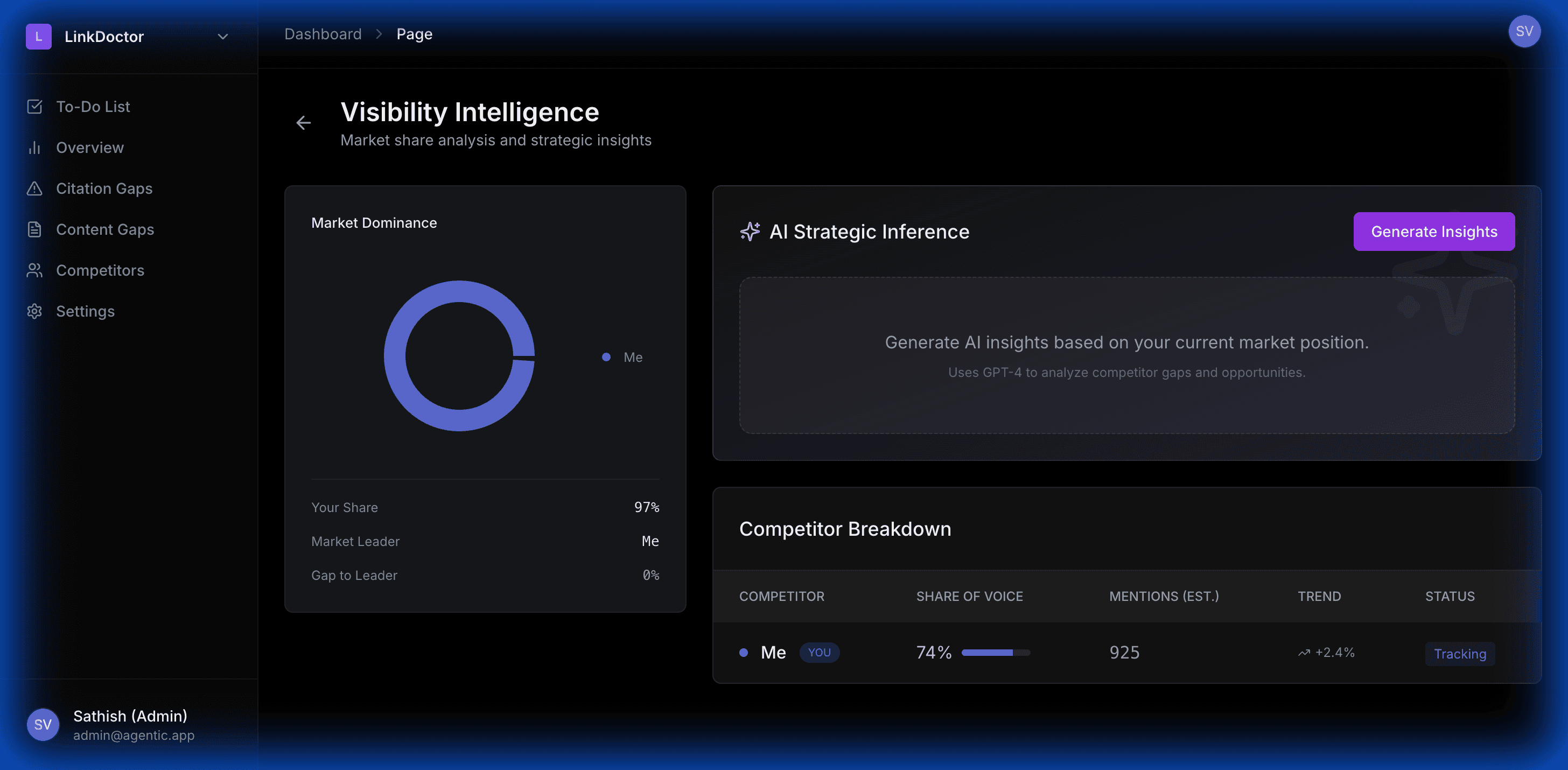
That competitor advantage can show up before rankings move. In our AI visibility gap case study, one scanned brand had 7 AI visibility mentions while its comparison competitors had hundreds of mentions across the same market.
- What your company does
- Which category you belong to
- Who your product is for
- Which use cases you support
- How you compare to alternatives
- What evidence supports your claims
- Which pages should be treated as canonical sources
Step 1: Make your entity clear
An entity is a named thing: a company, product, person, category, feature, or concept.
For AI search, your brand should be a clear entity. That means your site should consistently describe the same facts in the same way.
Weak positioning:
We help modern teams unlock growth with intelligent insights.
Stronger positioning:
AgentSEO is an AI visibility platform that helps SaaS teams monitor brand mentions, competitor presence, and citation gaps across AI answer engines.
The second version gives the model a category, audience, function, and use case. It is easier to understand and easier to repeat accurately.
Step 2: Build pages around buyer questions
AI search is question-led. Buyers ask natural-language questions, not just keywords.
Useful question patterns include:
Each important question should have a page or section that answers it directly. Start with a short answer, then add examples, proof, and next steps.
- What is the best tool for tracking AI visibility?
- How do I monitor brand mentions in ChatGPT?
- How can I improve answer engine optimization?
- Which competitors appear in AI search results?
- What are citation gaps in AI answers?
Step 3: Create comparison content
AI systems often answer recommendation queries by comparing options. If your website avoids comparisons, AI systems will gather that context from other sources.
Good comparison content includes:
The goal is not to publish thin pages that attack competitors. The goal is to explain fit. Who should choose you? Who should choose something else? Where are you strongest?
- Alternative pages
- Use-case pages
- Category guides
- Competitor comparison pages
- "Best tools for" articles
- Feature comparison tables
Step 4: Add evidence to important claims
AI search systems need reasons to trust the answer. Human buyers do too.
Support important claims with:
Avoid unsupported superlatives. "Best" is weak without evidence. "Built for SaaS teams that need prompt-level brand visibility across AI answer engines" is much clearer.
- Product screenshots
- Methodology notes
- Customer examples
- Public documentation
- Data from your own platform
- Clear limitations
- Named integrations
- Links to relevant source pages
Step 5: Improve crawlability
AI search strategy still depends on technical SEO.
Before submitting pages to Google Search Console, check that:
If Google cannot crawl or understand the page, it is harder for the wider search ecosystem to use it.
- Public pages are not behind login
- Important URLs are in the sitemap
- Canonical tags point to the final URL
- Robots.txt does not block the blog
- The page has one clear H1
- Headings follow a logical structure
- The page works on mobile
- Internal links point to the page
Step 6: Track the answers, not only the clicks
AI search performance cannot be measured only by sessions and rankings. A buyer can see your brand in an AI answer without clicking immediately.
Track:
This gives you a better picture of whether your content is shaping AI answers.
- Brand mentions
- Competitor mentions
- Citation sources
- Sentiment
- Category association
- Prompt-level visibility
- Missing use cases
A simple AI search strategy workflow
Use this workflow to get started:
This turns AI search from a vague trend into a measurable content workflow.
- List the questions buyers ask before choosing your product.
- Run those questions in AI answer engines.
- Record which brands and sources appear.
- Identify where your brand is missing or misrepresented.
- Improve existing pages or publish missing pages.
- Submit updated URLs in GSC.
- Re-test the same prompts after crawling.
Final takeaway
AI search rewards clarity. If your website clearly explains who you are, what you do, who you serve, and why you are trustworthy, AI systems have better material to work with.
The companies that win will not be the ones that publish the most content. They will be the ones that publish the clearest, most useful, most verifiable content in their category.
Sources and further reading
- Google Search Central: Creating helpful, reliable, people-first content
- Google Search Central: Article structured data
Keep the workflow moving
Turn the visibility lesson into a workflow
Use AgentSEO to inspect AI visibility, citations, competitors, and content gaps with outputs built for dashboards, APIs, and agent workflows.

Daniel Martin
Cofounder, AgentSEO
Inc. 5000 Honoree and cofounder of AgentSEO and Joy Technologies. Daniel has helped 600+ B2B companies grow through search and now writes about practical SEO infrastructure for AI agents, MCP workflows, and REST-first execution systems.
FAQ
Questions teams usually ask next
How is AI visibility different from traditional SEO?
Traditional SEO focuses on rankings, clicks, and page performance. AI visibility also tracks whether a brand is mentioned, cited, compared, and recommended inside AI-generated answers.
What should teams measure first?
Start with a stable prompt set, competitor mentions, owned-page citations, source quality, and the page or workflow that should be improved next.
More in this topic
AI visibility and AI search
Measurement
How to measure AI visibility: tracker, audit, and dashboard metrics that matter
Measure AI visibility with a repeatable system, not one synthetic score. Track mention rate, first mention, citations, source mix, and page-level movement across a fixed prompt set.
Measurement
AI search reporting dashboard: metrics, views, and workflow
A good AI search reporting dashboard separates discoverability, citations, prompts, competitors, and business outcomes. Build views that help operators decide what to change next.