AI Visibility: The Death of AEO
A practical guide to AI visibility: what it means, why it matters, and how to make your brand easier for ChatGPT, Perplexity, Gemini, Claude, and Google AI experiences to understand and cite.
Founders, growth teams, agencies, and technical marketers building repeatable AI visibility workflows
AI Visibility / AEO
Best Next Step
Turn the visibility lesson into a workflow
Use AgentSEO to inspect AI visibility, citations, competitors, and content gaps with outputs built for dashboards, APIs, and agent workflows.
Quick Brief
Best For
Founders, growth teams, agencies, and technical marketers building repeatable AI visibility workflows
Core Problem
A practical guide to AI visibility: what it means, why it matters, and how to make your brand easier for ChatGPT, Perplexity, Gemini, Claude, and Google AI experiences to understand and cite.
Read Shape
8 min read with scannable sections, proof blocks, and direct next actions.
Proof Inside
You’ll Cover
- What AI visibility means
- Why AEO is evolving
- AI visibility vs SEO vs AEO vs GEO
A practical guide to AI visibility: what it means, why it matters, and how to make your brand easier for ChatGPT, Perplexity, Gemini, Claude, and Google AI experiences to understand and cite.
What AI visibility means
AI visibility is the practice of making your brand easy for AI answer engines to understand, trust, and recommend.
Traditional SEO asks, "Can we rank for this query?" AI visibility asks a different question: "When a buyer asks an AI assistant for advice, are we part of the answer?"
That shift matters because AI systems do not behave like a normal search results page. They synthesize information from many sources, choose a few names to mention, and often send the user forward with a short list of brands, products, sources, or next steps.
If your company is not clearly described across its own site and the wider web, AI systems have less to work with. If your competitors have clearer positioning, stronger comparison pages, better evidence, and more third-party validation, they become easier to cite.
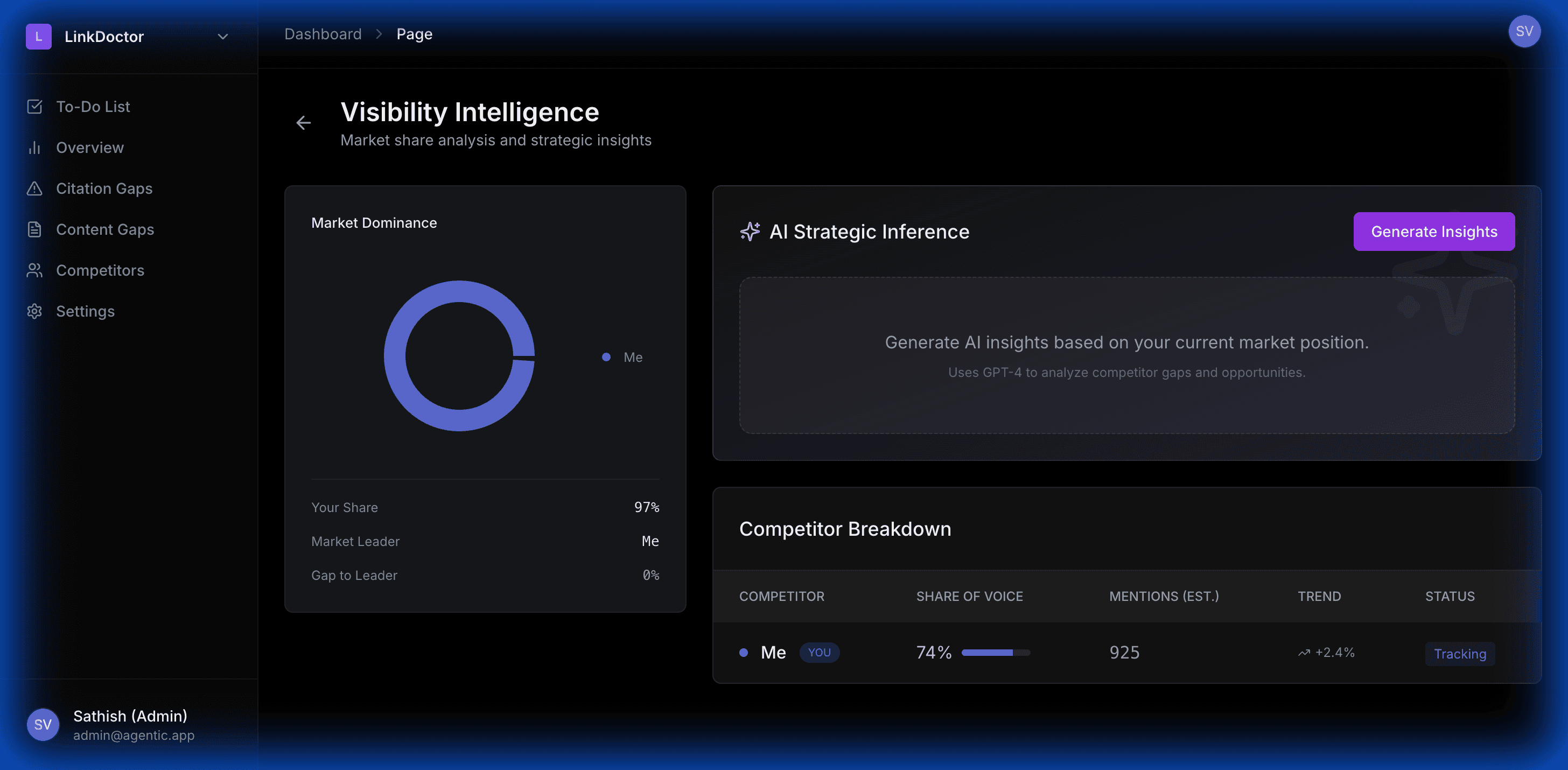
That gap can be surprisingly large. In one anonymized AgentSEO scan, a brand appeared 7 times while three competitors appeared 1,621 times combined. We break down that pattern in our AI visibility gap case study.
Why AEO is evolving
Answer Engine Optimization was a useful idea when the job was simple: structure content so answer engines could pull a concise response.
That is no longer enough.
Modern AI systems do not only extract answers. They compare vendors, summarize categories, evaluate source quality, and recommend next steps. That means the game is moving from answer formatting to brand understanding.
AEO is not useless. It is incomplete. The broader discipline is AI visibility.
AI visibility vs SEO vs AEO vs GEO
AI visibility, SEO, AEO, and GEO overlap, but they are not the same thing.
SEO is still important. AI engines need crawlable, well-structured pages to understand your business. But AI visibility goes beyond ranking. It is about becoming a known entity with enough supporting evidence that an AI answer can confidently include you.
| Concept | Main goal | What you optimize |
|---|---|---|
| SEO | Rank in organic search results | Pages, keywords, links, technical crawlability |
| AEO | Answer specific questions clearly | Concise explanations, FAQ structure, schema, snippets |
| GEO | Influence generative engine responses | Entity clarity, topical authority, source quality |
| AI visibility | Become a trusted source in AI-generated answers | Entity clarity, source authority, comparison coverage, citations, content depth |
Why it matters
Buyers increasingly use AI assistants before they visit vendor websites. They ask questions like:
Those questions can shape a shortlist before your sales team, ads, or homepage ever enter the conversation.
If your brand is absent from those answers, the demand loss is hard to measure. The buyer may never search for your name. They may never click an ad. They may simply choose a competitor because the AI assistant framed that competitor as the obvious option.
- What are the best tools for tracking AI search visibility?
- Which platforms monitor ChatGPT and Perplexity mentions?
- What are the alternatives to my current SEO tool?
- How do I know if AI assistants recommend my brand?
- Which company is best for a specific industry or use case?
What AI systems need to understand
The goal is not to trick the model. The goal is to make your company easier to understand and verify.
At minimum, your website should make these points unambiguous:
This sounds basic, but many SaaS sites make AI systems infer too much. They use vague hero copy, thin feature pages, missing comparison pages, and product language that changes from page to page. That creates ambiguity.
AI visibility improves when your content repeatedly, naturally, and accurately reinforces the same entity relationships.
- What category you belong to
- Who your product is for
- What problems you solve
- Which use cases you support
- How you are different from alternatives
- What proof supports your claims
- Which pages are canonical sources of truth
The AI visibility checklist
Use this checklist before publishing a page you want AI systems to understand.
1. Define the category clearly
Do not assume the model knows what you are. Say it plainly.
Weak:
We help teams unlock next-generation insights.
Stronger:
AgentSEO is an AI visibility platform that helps companies monitor how their brand appears in ChatGPT, Perplexity, Gemini, Claude, and Google AI experiences.
The second version gives AI systems a category, audience, function, and context.
2. Answer real buyer questions
Good AI visibility content is usually question-driven. It should map to the way buyers actually ask for advice.
Examples:
Each question can become a section, FAQ, guide, comparison page, or glossary entry.
- How do I track brand mentions in ChatGPT?
- How do I improve AI search visibility?
- What is the difference between AEO and GEO?
- How do AI assistants choose which brands to cite?
- What content should I create for answer engine optimization?
3. Build comparison coverage
AI assistants often answer recommendation queries by comparing options. If your site avoids comparison language entirely, you leave the model to gather that context elsewhere.
Useful comparison content includes:
The goal is not to attack competitors. The goal is to explain fit. Who should use your product? Who should not? Where are you strongest?
- Alternative pages
- "Best tools for" pages
- Category explainers
- Use-case pages
- Competitor comparison pages
- Pricing and packaging explainers
4. Add evidence, not just claims
AI systems need reasons to trust a recommendation. Unsupported claims are weak inputs.
Stronger evidence includes:
For AgentSEO, that means showing how AI visibility tracking works, which answer engines are monitored, how citation gaps are found, and what teams can do with the results.
- Screenshots of the product
- Methodology notes
- Customer examples
- Before-and-after workflows
- Named integrations
- Clear feature details
- Original research
- Public documentation
5. Keep pages crawlable and internally linked
AI visibility still depends on strong technical SEO fundamentals.
Important pages should be:
Google's own guidance emphasizes helpful, reliable, people-first content and clear technical discoverability. A page that is thin, hard to crawl, or created only to chase search traffic is unlikely to become a durable source.
- Available without login
- Linked from relevant navigation or hub pages
- Included in the XML sitemap when canonical
- Free from accidental noindex tags
- Fast enough to load reliably
- Written with descriptive headings
6. Use schema where it genuinely describes the page
Structured data can help search engines understand a page, but it should match the visible content. Blog posts can use Article or BlogPosting schema. Breadcrumb schema is useful when the page sits inside a clear site hierarchy.
Do not add schema for things that are not actually present on the page. For GSC and rich-result eligibility, structured data should be specific, accurate, and placed on the page it describes.
7. Refresh content when facts change
AI visibility is not a one-time publishing task. Your product changes. Competitors change. AI answer behavior changes. Your content should change with it.
Useful refresh triggers:
Do not change dates just to look fresh. Update the content when there is a real improvement.
- New feature launch
- New integration
- Pricing or packaging update
- Major category shift
- Competitor repositioning
- New customer segment
- Repeated AI answer gap
Mistake 1: Writing only for keywords
Keyword research is useful, but AI visibility content should not read like a keyword list. It should resolve the buyer's question completely enough that the page feels worth bookmarking.
Mistake 2: Hiding important context in images
AI systems and search engines can miss information that only appears inside images. Use screenshots, but put the important explanation in HTML text too.
Mistake 3: Publishing thin glossary pages
Glossary content can help, but only if each page adds real explanation, examples, and context. A one-paragraph definition rarely deserves to rank or be cited.
Mistake 4: Avoiding competitor names
If buyers compare you to alternatives, your site should help them make that comparison. Clear, fair competitor content gives AI systems more accurate context.
Mistake 5: Measuring only clicks
AI visibility often happens before a click. Track mentions, sentiment, citation sources, competitor presence, and the prompts where your brand is missing.
How AgentSEO helps
AgentSEO helps teams understand how they appear across AI answer engines.
With AgentSEO, you can:
The point is not to publish blindly. The point is to learn where AI systems already understand you, where they misunderstand you, and where they ignore you entirely.
- Track whether AI systems mention your brand
- See which competitors appear in the same answers
- Identify citation gaps where other sources are being used
- Find content gaps tied to buyer questions
- Monitor sentiment and positioning in AI-generated responses
- Prioritize pages that can improve visibility
A practical first 30 days
If you are just starting, use this simple plan.
Week 1: Establish your baseline
Run prompts around your core category, competitors, use cases, and buyer problems. Record where your brand appears, where competitors appear, and which sources are cited.
Week 2: Fix your owned pages
Update your homepage, feature pages, pricing page, about page, and top comparison pages so your category, audience, use cases, and proof are clear.
Week 3: Publish missing explainers
Create content for the questions where AI systems mention competitors but not you. Focus on pages that help real buyers make a decision.
Week 4: Re-test and prioritize
Run the same prompts again. Look for movement in mentions, citation sources, and answer framing. Use what changed to choose the next set of pages.
Final takeaway
AI visibility is not magic. It is the result of clear positioning, useful content, crawlable pages, trustworthy evidence, and consistent measurement.
If AI assistants are becoming a new front door for buyers, your website needs to act like a source they can understand and trust.
Sources and further reading
- Google Search Central: Creating helpful, reliable, people-first content
- Google Search Central: Article structured data
- Google Search Central: General structured data guidelines
Keep the workflow moving
Turn the visibility lesson into a workflow
Use AgentSEO to inspect AI visibility, citations, competitors, and content gaps with outputs built for dashboards, APIs, and agent workflows.

Daniel Martin
Cofounder, AgentSEO
Inc. 5000 Honoree and cofounder of AgentSEO and Joy Technologies. Daniel has helped 600+ B2B companies grow through search and now writes about practical SEO infrastructure for AI agents, MCP workflows, and REST-first execution systems.
FAQ
Questions teams usually ask next
How is AI visibility different from traditional SEO?
Traditional SEO focuses on rankings, clicks, and page performance. AI visibility also tracks whether a brand is mentioned, cited, compared, and recommended inside AI-generated answers.
What should teams measure first?
Start with a stable prompt set, competitor mentions, owned-page citations, source quality, and the page or workflow that should be improved next.
More in this topic
AI visibility and AI search
Measurement
How to measure AI visibility: tracker, audit, and dashboard metrics that matter
Measure AI visibility with a repeatable system, not one synthetic score. Track mention rate, first mention, citations, source mix, and page-level movement across a fixed prompt set.
Measurement
AI search reporting dashboard: metrics, views, and workflow
A good AI search reporting dashboard separates discoverability, citations, prompts, competitors, and business outcomes. Build views that help operators decide what to change next.