AI Visibility Gap Case Study: When Competitors Own the Answer Before You Do
An anonymized AgentSEO scan shows how one brand had only 7 AI visibility mentions while competitors appeared hundreds of times across the same market.
Founders, growth teams, agencies, and technical marketers building repeatable AI visibility workflows
AI Visibility / Competitor Intelligence
Best Next Step
Turn the visibility lesson into a workflow
Use AgentSEO to inspect AI visibility, citations, competitors, and content gaps with outputs built for dashboards, APIs, and agent workflows.
Quick Brief
Best For
Founders, growth teams, agencies, and technical marketers building repeatable AI visibility workflows
Core Problem
An anonymized AgentSEO scan shows how one brand had only 7 AI visibility mentions while competitors appeared hundreds of times across the same market.
Read Shape
8 min read with scannable sections, proof blocks, and direct next actions.
Proof Inside
You’ll Cover
- The mistake: treating AI visibility like a homepage copy problem
- The proof from the scan
- What the numbers actually mean
Most teams do not have an AI visibility problem because their brand is bad.
They have an AI visibility problem because AI systems have found easier brands to explain.
That is the uncomfortable part. A company can have a useful product, a real market, happy customers, and decent SEO basics, but still be nearly absent when AI systems answer buying questions.
In one recent AgentSEO scan for a creator-services brand, the gap was blunt:
The mistake: treating AI visibility like a homepage copy problem
The first instinct is usually to rewrite the homepage.
That can help, but it is rarely the whole problem.
AI answer engines do not learn a brand from one page. They assemble a picture from homepage copy, category pages, comparison pages, review sites, directories, listicles, social profiles, cited sources, and the language other websites use around the market.
If competitors have more complete source coverage, clearer category language, and stronger third-party mentions, AI systems have more material to work with.
The problem is not only "our positioning is unclear."
The deeper problem is:
AI systems have more evidence for competitors than they have for us.
That changes the fix. You are not just editing copy. You are building a source map across AI visibility, competitor intelligence, and citation coverage.
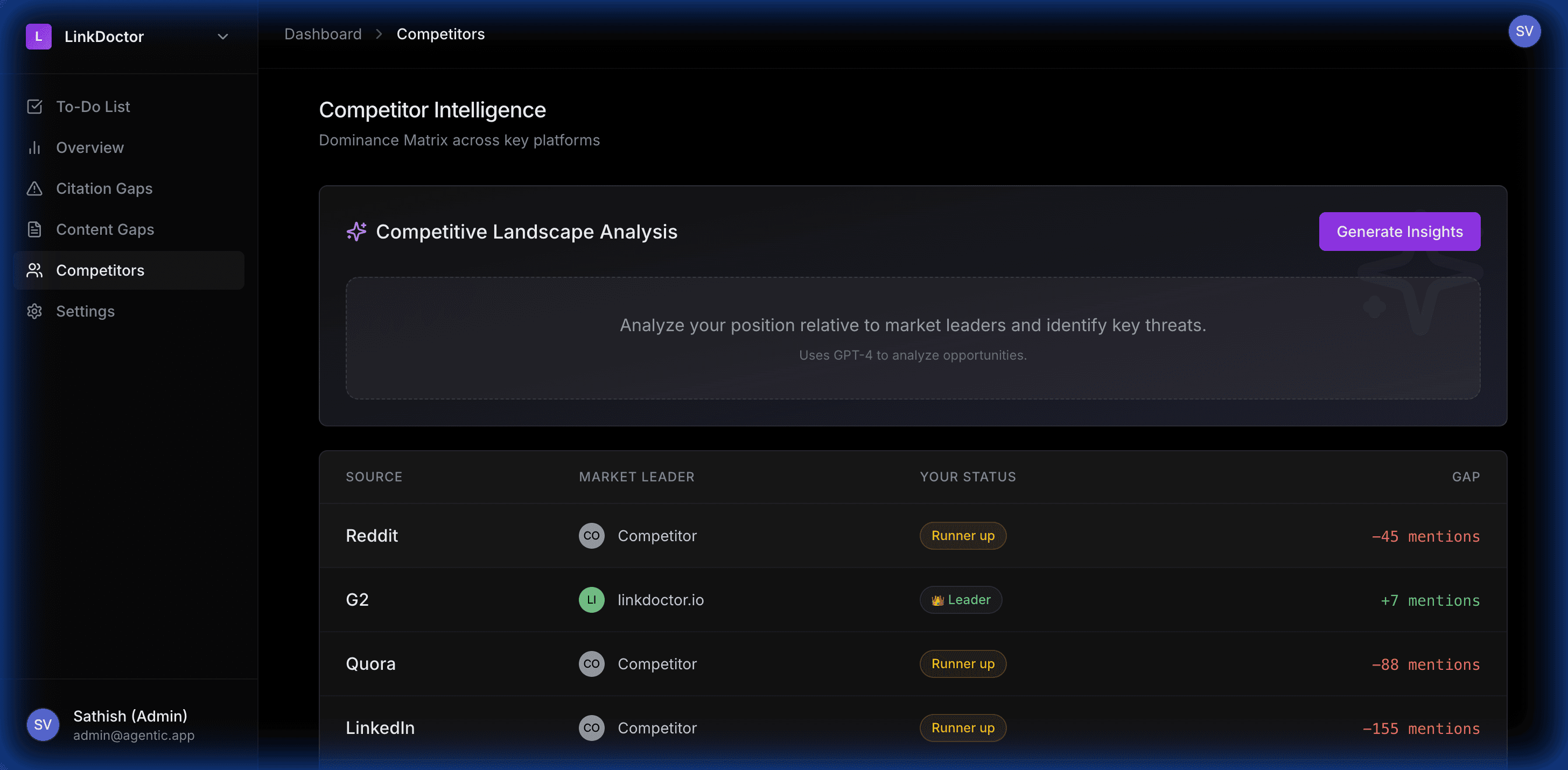
The proof from the scan
The scan showed a large visibility gap across a small competitive set.
The scanned brand appeared 7 times. The top competitor appeared 995 times. The second competitor appeared 597 times. Even the third competitor, which was much smaller than the top two, appeared 29 times.
The gap between the scanned brand and the top competitor was about 142x.
The combined competitor gap was larger: the three comparison competitors appeared 1,621 times against 7 mentions for the scanned brand.
Those numbers do not mean the scanned brand can never win.
They mean the market already has a learned pattern. AI systems have seen competitor names, competitor pages, competitor categories, and competitor evidence more often than they have seen the scanned brand.
For a founder or CMO, that is useful. It turns "AI search feels scary" into a concrete competitive map.
| Comparison | Mentions | Gap vs scanned brand |
|---|---|---|
| Scanned brand | 7 | Baseline |
| Top competitor | 995 | 142x |
| Second competitor | 597 | 85x |
| Third competitor | 29 | 4x |
| Combined competitors | 1,621 | 232x |
What the numbers actually mean
An AI visibility gap is not the same as a traffic gap.
Traffic tells you who reached your site.
AI visibility tells you whether your brand was present before the click ever happened.
That matters because many AI-assisted buying journeys start with questions like:
If the AI answer mentions three competitors and leaves your brand out, you may never see the lost demand in analytics.
There is no abandoned cart. There is no failed signup. There is no obvious paid search keyword to inspect.
The buyer simply learns the category through someone else's brand.
- Which services help creators edit short-form video?
- What are the best options for podcast repurposing?
- Which platforms are good for YouTube Shorts editing?
- What alternatives should I compare before hiring an editing service?
- Which companies are trusted for creator video production?
Why competitors get mentioned first
In most scans, competitor advantage comes from a mix of five signals.
This is where traditional SEO advice can break.
A page can be optimized for a keyword and still be weak as an AI source. AI systems need concise definitions, structured claims, examples, entities, proof, and trustworthy context.
The winning competitor may not have a magical AI strategy. It may simply have more pages and sources that answer the model's implied questions.
| Signal | What AI systems can learn |
|---|---|
| Clear category language | What the company does and who it serves |
| Comparison coverage | How the company relates to alternatives |
| Third-party mentions | Whether outside sources recognize the brand |
| Use-case pages | Which buyer problems the company solves |
| Citation-worthy content | Which pages can support a direct answer |
How to diagnose the gap
The fastest way to diagnose an AI visibility gap is to separate the problem into prompts, competitors, sources, and pages.
Start with five prompt groups:
Then check four things for each group:
That last question is usually where the work becomes obvious.
If there is no strong page for the prompt, the AI system has to learn from someone else.
- Does your brand appear?
- Which competitors appear instead?
- Which sources are cited or reflected in the answer?
- Which page would you want AI systems to cite if they needed a source?
| Prompt group | Example question |
|---|---|
| Category | What are the best tools or services for this job? |
| Use case | What should a buyer use for a specific workflow? |
| Comparison | How does this brand compare with alternatives? |
| Problem | How should a buyer solve the underlying pain? |
| Decision | Which option is best for a specific buyer type? |
What to do when competitors own the answer
Do not respond by publishing ten thin "best X" posts.
Respond by building the missing evidence layer.
1. Create a source-of-truth page for the category
Your category page should explain:
This page should be clear enough that an AI system can summarize it without guessing.
- What the category is
- Who it is for
- What problems it solves
- What buyers should compare
- Where your product or service fits
2. Add use-case pages tied to buyer questions
Use-case pages work because AI answers often start from jobs-to-be-done, not brand names.
If buyers ask about podcast clipping, creator video editing, LinkedIn content repurposing, or short-form video workflows, each important use case deserves a specific page or section.
The page should answer the question directly, then show proof.
3. Build fair comparison content
Competitor content does not need to be aggressive.
It needs to be useful.
AI systems are more likely to understand your place in the market when your site clearly explains who should choose you, who should choose an alternative, and where the tradeoffs are.
Avoid vague claims like "better quality" or "faster workflow." Use concrete dimensions:
- buyer type
- budget
- turnaround time
- service model
- integrations
- content formats
- reporting needs
4. Strengthen third-party proof
Your own website is only one source.
If AI systems keep citing directories, listicles, review pages, podcasts, YouTube descriptions, social profiles, or partner pages, treat those as part of the visibility system.
The question becomes:
Which sources already influence the answer, and how do we earn or improve our presence there?
That is citation-gap work, not normal blog writing.
5. Turn content gaps into briefs
A content gap is not just "we need a blog post."
It is a prompt where a buyer asks a meaningful question and your brand has no strong answer.
For each gap, create a brief that includes:
That turns AI visibility from a vague growth channel into an operating system for content.
- target prompt
- buyer intent
- competitors currently appearing
- sources being cited
- page type needed
- proof required
- internal links to add
The AgentSEO insight
The first useful AI visibility scan is rarely a scorecard.
It is usually a map of where the market has already been taught to trust someone else.
That is why the mention gap matters. The scanned brand with 7 mentions was not looking at a simple ranking problem. It was looking at an evidence problem.
Competitors had more learned associations. More source coverage. More category context. More chances to be included when AI systems assembled an answer.
The fix is not one perfect article. It is a sequence:
That is the shift from content marketing to AI visibility operations.
- Find prompts where competitors appear and you do not.
- Identify the sources shaping those answers.
- Create or improve the pages that should answer those prompts.
- Earn or update the third-party sources AI systems already trust.
- Re-scan and watch whether the mention gap narrows.
Final takeaway
AI visibility gaps are measurable.
That is the good news. If a competitor appears 995 times and your brand appears 7 times, the problem is no longer abstract.
You can see the prompts, competitors, sources, and missing pages behind the gap.
Start there. Find where AI systems already trust competitors more than you. Then build the evidence those systems need to mention, cite, and recommend your brand.
AgentSEO exists for that workflow: scanning the prompts, citations, competitors, sentiment, and content gaps that shape AI-assisted demand. Start with an AI visibility scan when you need to see where competitors are already winning the answer.
Methodology note
This article is based on an anonymized AgentSEO scan of a creator-services market. The numbers reflect observed AI visibility mentions across the scanned brand and three comparison competitors in that analysis. The brand names are withheld to protect user privacy, and the findings are used here as a directional example of how competitor visibility gaps can appear in AI answer research.
Keep the workflow moving
Turn the visibility lesson into a workflow
Use AgentSEO to inspect AI visibility, citations, competitors, and content gaps with outputs built for dashboards, APIs, and agent workflows.

Daniel Martin
Cofounder, AgentSEO
Inc. 5000 Honoree and cofounder of AgentSEO and Joy Technologies. Daniel has helped 600+ B2B companies grow through search and now writes about practical SEO infrastructure for AI agents, MCP workflows, and REST-first execution systems.
FAQ
Questions teams usually ask next
What is an AI visibility gap?
An AI visibility gap is the difference between how often your brand and your competitors appear, get cited, or get recommended across AI answer journeys.
What should teams do after finding a visibility gap?
Map the missing prompts, cited sources, competitor pages, and owned pages, then turn the highest-impact gaps into content, comparison, citation, and monitoring workflows.
More in this topic
AI visibility and AI search
Measurement
How to measure AI visibility: tracker, audit, and dashboard metrics that matter
Measure AI visibility with a repeatable system, not one synthetic score. Track mention rate, first mention, citations, source mix, and page-level movement across a fixed prompt set.
Measurement
AI search reporting dashboard: metrics, views, and workflow
A good AI search reporting dashboard separates discoverability, citations, prompts, competitors, and business outcomes. Build views that help operators decide what to change next.