The AI Visibility Trial Math: Why SaaS Teams Need to See Their Data Before They Pay
Our internal trial research shows why AI visibility tools should deliver personalized value before asking for payment, especially for mid-market SaaS teams.
Founders, growth teams, agencies, and technical marketers building repeatable AI visibility workflows
AI Visibility / SaaS Growth
Best Next Step
Turn the visibility lesson into a workflow
Use AgentSEO to inspect AI visibility, citations, competitors, and content gaps with outputs built for dashboards, APIs, and agent workflows.
Quick Brief
Best For
Founders, growth teams, agencies, and technical marketers building repeatable AI visibility workflows
Core Problem
Our internal trial research shows why AI visibility tools should deliver personalized value before asking for payment, especially for mid-market SaaS teams.
Read Shape
8 min read with scannable sections, proof blocks, and direct next actions.
Proof Inside
You’ll Cover
- The numbers behind the trial decision
- The 100-click example
- Why AI visibility tools are different
Most SaaS trial debates are framed too simply.
One side says, "Require a credit card. You will get better customers." The other side says, "Remove the credit card. You will get more signups."
Both are partly right. Both are also incomplete.
For AI visibility tools, the real question is not whether you should ask for a credit card. The real question is when the buyer sees value.
The numbers behind the trial decision
In our trial model, we compared three common SaaS onboarding flows.
The key insight is that trial-to-paid conversion alone can be misleading.
Credit-card-before-value flows often produce the highest trial-to-paid rate because they filter out nearly everyone except the most committed buyers. But they can also shrink the top of the funnel so much that total paid conversion falls.
For a mid-market SaaS product in the $29-$179 per month range, the better question is:
Which flow produces the most paid customers from the same demand?
| Trial model | Signup volume | Trial conversion | Trial-to-paid | Best fit |
|---|---|---|---|---|
| No credit card trial | Highest | 60-70% | 18-25% | High-volume, low-touch products |
| Credit card after value | Medium | 80-90% | 35-45% | Mid-market SaaS |
| Credit card before value | Lowest | 40-50% | 49-60% | Enterprise or high-intent tools |
The 100-click example
Here is the simplified model from our research.
This is why "credit card required converts better" is not a complete strategy.
Yes, asking for a card can increase trial-to-paid conversion. But if you ask before the user sees value, you may lose too many qualified buyers before the trial begins.
The better flow is often:
That is not a softer funnel. It is a more informed one.
- Sign up.
- Enter domain and competitors.
- Run a limited scan.
- Show a personalized dashboard preview.
- Gate deeper features, history, exports, or ongoing monitoring.
- Ask for payment when the user understands what they are unlocking.
| Flow | Funnel from 100 ad clicks | Overall paid conversion |
|---|---|---|
| No credit card trial | 100 clicks -> 40 signups -> 30 trials -> 7 paid | 7% |
| Credit card after value | 100 clicks -> 25 signups -> 22 trials -> 10 paid | 10% |
| Credit card before value | 100 clicks -> 10 signups -> 8 trials -> 5 paid | 5% |
Why AI visibility tools are different
AI visibility products have a time-to-value problem.
With a simple utility, value can appear in seconds. With an AI visibility platform, value depends on collecting or generating data:
That means the "aha moment" is not a generic screen. It is the first moment the user sees their own brand in the context of AI answers.
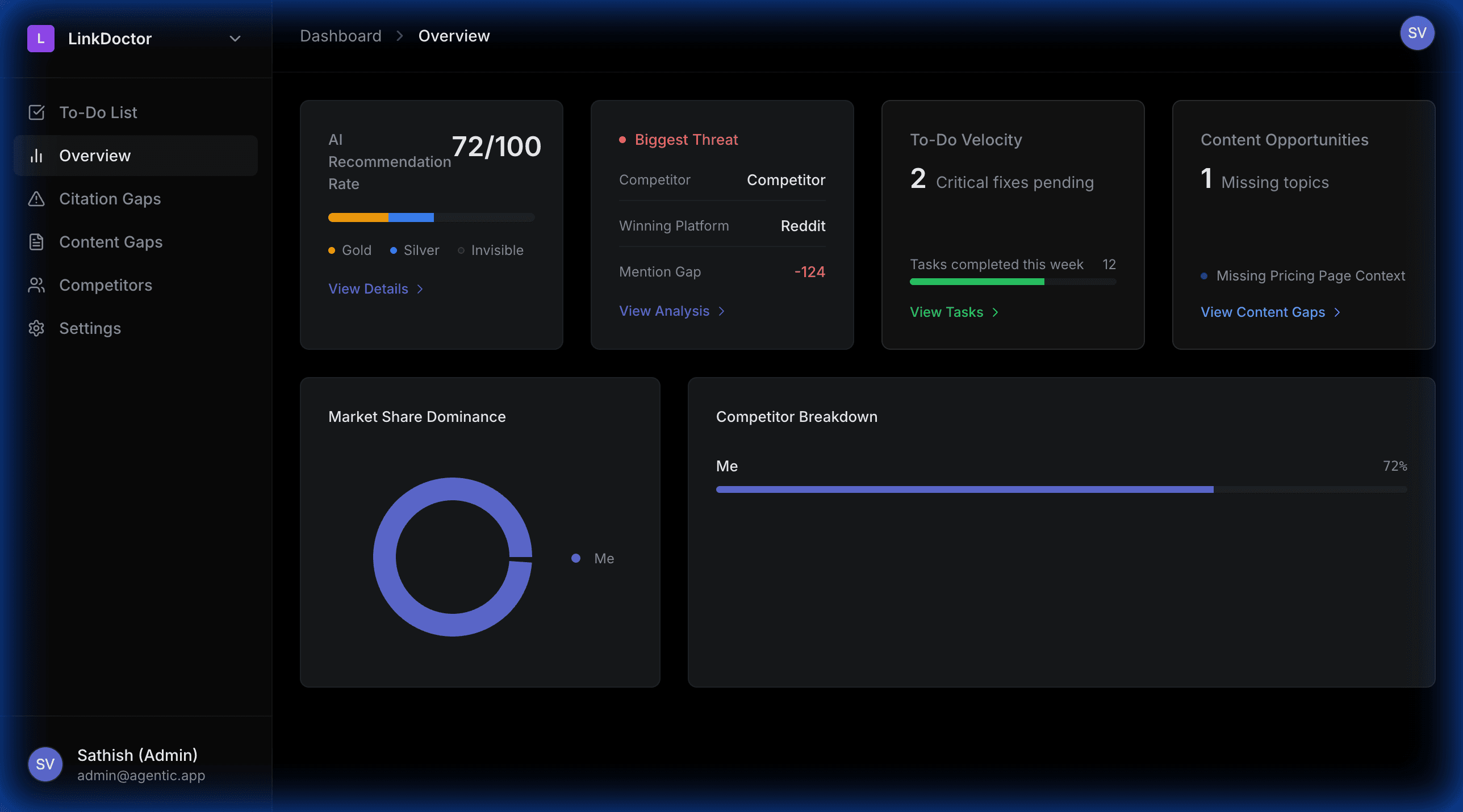
For AgentSEO, that value might look like:
That kind of result is hard to communicate on a pricing page. It becomes obvious when the user sees their own data.
- Which prompts matter for the buyer's category?
- Which competitors appear in AI answers?
- Which sources are being cited?
- What sentiment does the answer carry?
- Where is the brand missing?
- Which pages could improve visibility?
- "Your competitor appears in prompts where you do not."
- "AI answers cite third-party sources instead of your pages."
- "Your brand is visible for category prompts but missing from comparison prompts."
- "Your strongest content gap is tied to a specific buyer question."
The mistake: putting the payment wall before the proof
The weakest onboarding flow looks like this:
The problem is not the credit card. The problem is the order.
You are asking for commitment before evidence.
For a known enterprise tool with a large budget and a sales process, that may work. For a mid-market SaaS buyer evaluating a newer category like AI visibility, it is risky.
They may understand the pain, but they still need proof that the product can show something useful about their brand.
- User signs up.
- User sees pricing.
- User enters card details.
- User starts trial.
- User enters domain and competitors.
- Scan runs.
- Dashboard appears.
- User finally sees value.
The better model: personalized value before payment
A stronger AI visibility trial gives the user a limited but real result before asking for the card.
The flow looks like this:
This does three things.
First, it proves the product understands the user's business.
Second, it turns the payment wall into an upgrade moment rather than an interruption.
Third, it gives the buyer a concrete reason to continue: their own data.
- User signs up.
- User enters their domain.
- User adds two or three competitors.
- Product runs a limited visibility scan.
- User sees a preview of their AI visibility baseline.
- Product shows what is locked behind the paid trial.
- User starts the paid trial with context.
What to show before the payment wall
The preview does not need to give away the entire product.
For an AI visibility workflow, a strong pre-payment preview can show:
The goal is not to provide every answer. The goal is to make the next step feel obvious.
Weak upgrade prompt:
Start your trial to access the dashboard.
Stronger upgrade prompt:
We found 14 prompts where competitors appear and your brand does not. Start your trial to see the full gap list, citation sources, and recommended pages to create.
The second prompt is specific. It is tied to the user's data. It makes payment feel connected to value.
- Overall visibility score
- One or two competitor comparisons
- A sample AI answer where the brand appears or is missing
- A citation source preview
- A top content gap
- A locked section showing what full access unlocks
Why this matters for AI visibility adoption
AI visibility is still a new category for many teams.
Buyers may understand SEO. They may understand brand monitoring. They may even understand rank tracking. But prompt-level visibility, citation gaps, and AI answer sentiment are newer workflows.
New workflows need proof faster.
If the buyer has to pay before they understand the workflow, they may bounce. If they see a concrete visibility gap first, the category becomes real.
That is especially important for:
These buyers do not just need a feature list. They need a reason to believe AI visibility is measurable and actionable.
- SaaS founders evaluating a new growth channel
- SEO teams defending organic visibility
- Product marketers tracking competitive positioning
- Agencies pitching AI search retainers
- Growth teams comparing content opportunities
What the numbers imply
Our model suggests three practical rules.
1. Do not optimize only for trial-to-paid rate
A higher trial-to-paid rate can hide a weak funnel if too many qualified users abandon before activation.
Look at paid customers per 100 visitors, not just paid customers per trial.
2. Move the aha moment before the card
For AI visibility, the aha moment is personalized data. Show enough of it before payment to prove the product has value.
3. Gate depth, not proof
Do not hide the entire product behind a payment wall. Hide the deeper workflow:
Let the user see the proof. Then ask them to pay for the system.
- Full prompt list
- Historical tracking
- Exports
- Team seats
- Competitor expansion
- Full citation source analysis
- Recommended content briefs
The practical recommendation
For a mid-market AI visibility SaaS, the strongest default is:
Free or low-friction signup, limited personalized scan, dashboard preview, then credit-card trial for full access.
That model respects both sides of the funnel.
It keeps quality high because the paid trial still requires commitment. But it also gives qualified buyers a reason to commit before asking for payment.
In our model, this "credit card after value" path produced the strongest overall paid conversion from the same 100-click demand pool: 10%, compared with 7% for no-card trials and 5% for card-before-value trials.
The exact numbers will vary by product, traffic source, and buyer intent. The principle is more durable:
The more personalized the product value, the more important it is to show proof before payment.
Final takeaway
AI visibility is not an impulse purchase. It is a belief shift.
The buyer has to believe that AI answers influence demand. Then they have to believe their brand can be measured. Then they have to believe your product can show them what to do next.
That belief does not come from a pricing page.
It comes from seeing their own brand, competitors, prompts, citations, and gaps in the product.
Show the proof first. Gate the depth second. Ask for payment when the buyer understands what they are buying.
That is the trial math AI visibility products should be built around.
Methodology note
This article is based on AgentSEO's internal onboarding research and funnel modeling for mid-market SaaS products in the $29-$179 per month range. The model compared signup volume, trial activation, and trial-to-paid conversion across no-card trials, card-before-value trials, and card-after-value trials.
Keep the workflow moving
Turn the visibility lesson into a workflow
Use AgentSEO to inspect AI visibility, citations, competitors, and content gaps with outputs built for dashboards, APIs, and agent workflows.

Daniel Martin
Cofounder, AgentSEO
Inc. 5000 Honoree and cofounder of AgentSEO and Joy Technologies. Daniel has helped 600+ B2B companies grow through search and now writes about practical SEO infrastructure for AI agents, MCP workflows, and REST-first execution systems.
FAQ
Questions teams usually ask next
Should an AI visibility product ask for a credit card before the first scan?
Usually no for mid-market and product-led funnels. The buyer needs to see their own domain, competitors, prompts, and visibility gaps before the payment moment feels informed.
What should be gated after the first AI visibility scan?
Gate history, exports, ongoing monitoring, deeper competitor analysis, and workflow automation after the first useful preview has shown the buyer why the data matters.
More in this topic
AI visibility and AI search
Measurement
How to measure AI visibility: tracker, audit, and dashboard metrics that matter
Measure AI visibility with a repeatable system, not one synthetic score. Track mention rate, first mention, citations, source mix, and page-level movement across a fixed prompt set.
Measurement
AI search reporting dashboard: metrics, views, and workflow
A good AI search reporting dashboard separates discoverability, citations, prompts, competitors, and business outcomes. Build views that help operators decide what to change next.