Generative Engine Optimization (GEO): The Founder's Guide to AI Visibility in 2026
A founder-friendly guide to GEO and AI visibility: how to make your brand clearer, more trusted, and easier for generative engines to recommend.
Founders, growth teams, agencies, and technical marketers building repeatable AI visibility workflows
GEO / AI Visibility
Best Next Step
Turn the visibility lesson into a workflow
Use AgentSEO to inspect AI visibility, citations, competitors, and content gaps with outputs built for dashboards, APIs, and agent workflows.
Quick Brief
Best For
Founders, growth teams, agencies, and technical marketers building repeatable AI visibility workflows
Core Problem
A founder-friendly guide to GEO and AI visibility: how to make your brand clearer, more trusted, and easier for generative engines to recommend.
Read Shape
5 min read with scannable sections, proof blocks, and direct next actions.
Proof Inside
You’ll Cover
- GEO vs SEO vs AEO
- Why founders should lead GEO
- 1. Authority
Generative Engine Optimization, or GEO, is the practice of making your brand easier for generative AI systems to understand, trust, and recommend.
For founders, this matters because buyers increasingly ask AI assistants for product recommendations, vendor comparisons, implementation advice, and category explanations.
If those systems do not understand your company, you may be invisible during the research stage.
GEO is not about tricking AI. It is about making your company easier to verify.
GEO vs SEO vs AEO
GEO overlaps with SEO and AEO, but it has a broader goal.
Founders should care about all three. SEO helps pages get discovered. AEO helps pages answer questions. GEO helps the brand become part of AI-generated recommendations and summaries.
| Discipline | Focus |
|---|---|
| SEO | Improve visibility in search results |
| AEO | Structure content to answer specific questions |
| GEO | Improve how generative engines understand and describe your brand |
Why founders should lead GEO
GEO is not only a content task. It touches positioning, product marketing, customer proof, partnerships, and category design.
Founders are often closest to:
If that context is not clearly reflected on the website, AI systems will rely on weaker signals.
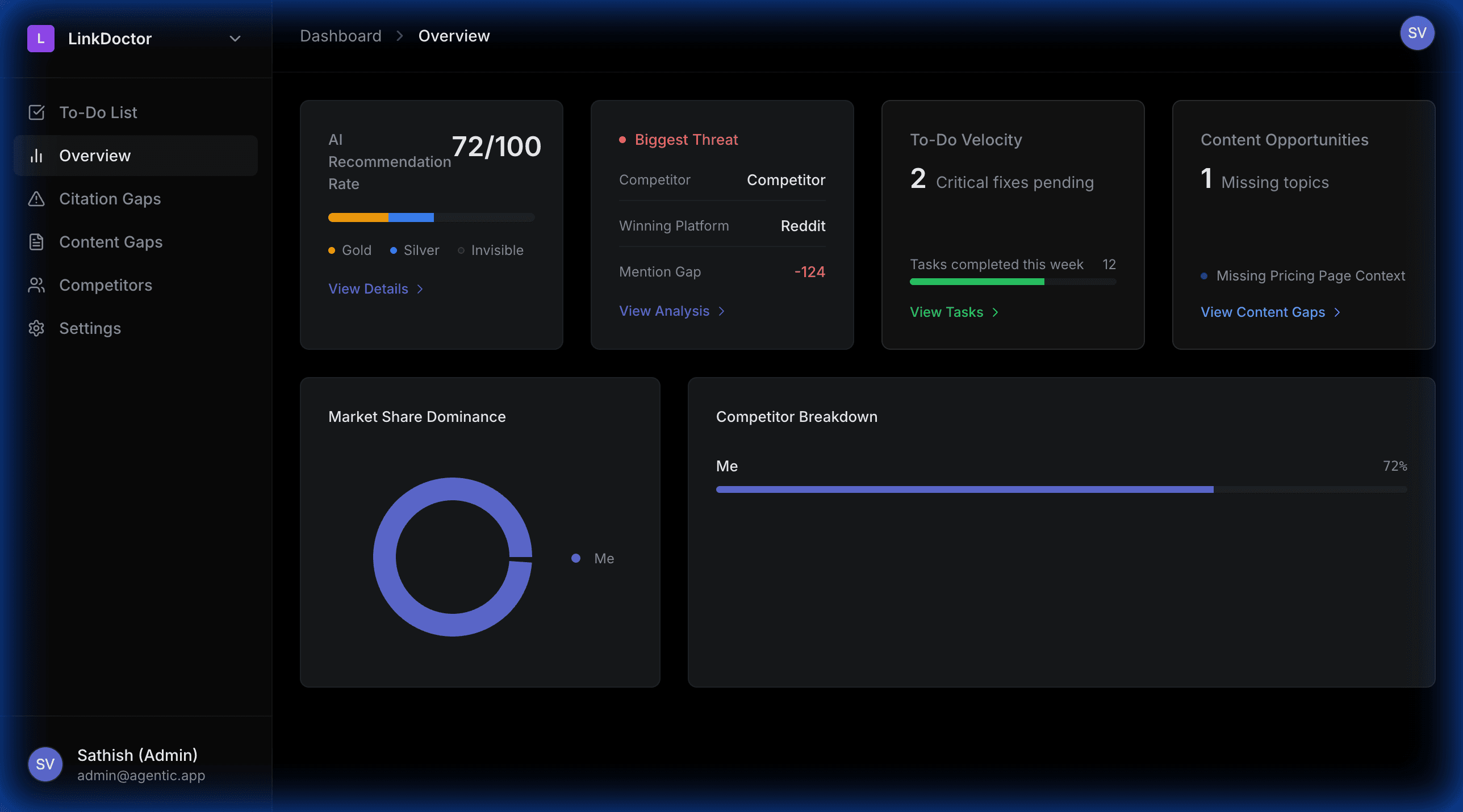
The founder-level risk is not theoretical. In an anonymized AgentSEO scan, one brand had 7 AI visibility mentions while three competitors had 1,621 combined. The AI visibility gap case study shows why founders should treat GEO as a source and proof problem, not just a blog calendar.
- The company narrative
- The market shift
- The strongest customer pain
- The real differentiation
- The long-term category bet
2. Relevance
Relevance means your pages match the questions buyers ask.
For an AI visibility platform, relevant questions might include:
If your site does not answer those questions, AI systems may cite sources that do.
- How do I track ChatGPT brand mentions?
- What are citation gaps?
- How do AI assistants choose which brands to recommend?
- How do I compare AI visibility tools?
- How can SaaS teams monitor competitor presence in AI answers?
3. Trust
Trust means the content is accurate, clear, and not exaggerated.
Trust improves when you:
Trust is the anchor that makes authority and relevance useful.
- Avoid inflated claims
- Explain limitations
- Keep dates accurate
- Update pages when facts change
- Link related pages clearly
- Show who created the content
- Use schema that matches the visible page
What founders should publish first
If you are starting from scratch, publish the pages that clarify your category and buying context.
Priority pages:
Do not publish these as thin templates. Each page should help a real buyer understand something important.
- Category explainer
- Product overview
- Use-case pages
- Comparison pages
- Alternatives pages
- Customer proof
- Methodology page
- Founder or company point-of-view page
How to make your brand easier to recommend
Generative engines need clear, repeatable facts.
Make these facts easy to find:
If the same facts appear consistently across your site and trusted third-party sources, AI systems have less ambiguity to resolve.
- Brand name
- Product name
- Category
- Target customer
- Core use cases
- Differentiators
- Pricing model
- Integrations
- Proof points
- Limitations
Mistake 1: Vague homepage copy
Founders often prefer broad language because it feels bigger. But vague language is hard for AI systems to classify.
Be specific before you become poetic.
Mistake 2: No comparison content
If buyers compare you to alternatives, your site should help them do it. Otherwise, AI systems will use competitor pages, review sites, and third-party summaries to fill the gap.
Mistake 3: No proof
Claims without evidence are weak. Add screenshots, customer examples, methodology, and documentation.
Mistake 4: Measuring only website traffic
AI visibility can influence buyers before they click. Track brand mentions, citations, and answer quality in addition to traffic.
A founder's GEO workflow
Use this monthly workflow:
This gives founders a practical loop: observe, publish, verify, repeat.
- Run prompts for your category, competitors, and use cases.
- Record which brands and sources appear.
- Identify prompts where your brand is missing or misdescribed.
- Improve the most relevant owned pages.
- Build or earn supporting third-party proof.
- Submit updated pages in GSC.
- Re-test prompts after crawling.
Final takeaway
GEO is category design for the AI search era.
If you want generative engines to understand your company, you need clear positioning, useful content, trustworthy proof, and consistent measurement.
The founders who win will not be the ones who chase every prompt. They will be the ones who make their brand unmistakably clear.
Sources and further reading
- Google Search Central: Creating helpful, reliable, people-first content
- Google Search Central: General structured data guidelines
Keep the workflow moving
Turn the visibility lesson into a workflow
Use AgentSEO to inspect AI visibility, citations, competitors, and content gaps with outputs built for dashboards, APIs, and agent workflows.

Daniel Martin
Cofounder, AgentSEO
Inc. 5000 Honoree and cofounder of AgentSEO and Joy Technologies. Daniel has helped 600+ B2B companies grow through search and now writes about practical SEO infrastructure for AI agents, MCP workflows, and REST-first execution systems.
FAQ
Questions teams usually ask next
How is AI visibility different from traditional SEO?
Traditional SEO focuses on rankings, clicks, and page performance. AI visibility also tracks whether a brand is mentioned, cited, compared, and recommended inside AI-generated answers.
What should teams measure first?
Start with a stable prompt set, competitor mentions, owned-page citations, source quality, and the page or workflow that should be improved next.
More in this topic
AI visibility and AI search
Measurement
How to measure AI visibility: tracker, audit, and dashboard metrics that matter
Measure AI visibility with a repeatable system, not one synthetic score. Track mention rate, first mention, citations, source mix, and page-level movement across a fixed prompt set.
Measurement
AI search reporting dashboard: metrics, views, and workflow
A good AI search reporting dashboard separates discoverability, citations, prompts, competitors, and business outcomes. Build views that help operators decide what to change next.